
THE FIELD OF MIRACLES
The big tax scams, the accomplices who didn’t know they were and what we could have done with the loot
«… Your five gold coins, overnight would have become two thousand.
“Two thousand!” repeated the Cat.
“But how is it possible that they should become so many?” asked Pinocchio, …..
—…..In the country of the Barn Owls there is a blessed field, called by everyone the Field of Miracles….. You make a small hole in this field and put in it, for example, a gold gold coin. Then you cover the hole with a little earth: you water it with two buckets of fountain water, you throw a pinch of salt on it, and in the evening you go quietly to bed. Meanwhile, during the night, the gold coin sprouts and blooms, and when you go back to the field the next morning, what do you find? You find a beautiful tree laden with as many gold gold coins as a beautiful ear of wheat can have in the month of June.
“So then,” said Pinocchio, more and more astonished, “if I were to bury my five gold coins in that field, how many gold coins would I find there the next morning?”
“It is a very easy count; “a count you can do on the tips of your fingers,” replied the Fox.
It was 1883, but the sum behind every scam is still “very easy”: they promise something in exchange for nothing, they always find someone willing to believe it and leave the bill to those who had nothing to do with it. And often, without knowing it, we also lend a hand.
Come on, get in, I’ll take you on a ride on the merry-go-round.
- Building bonuses and credits that did not exist
A bite of panzerotto
Rimini, January 2022. The Guardia di Finanza announces the “Free Credit” operation, according to the prosecution 440 million euros of non-existent tax credits, obtained from the measures of the Relaunch Decree. They were the credit on 60 percent of the rents paid by companies during the pandemic, the seismic bonus and the façade bonus. The scam was divided into three phases.
First phase, the box. Companies in serious difficulty or already insolvent were sought, with at least one lease or a property to be “renovated”. The legal representative was replaced by a figurehead, who gave the real masterminds the credentials to enter the reserved area of the Revenue Agency. The company remained an empty shell, and the figurehead acted as a screen in case of checks.
Second phase, credit. Communications started from the reserved area: inflated rents, in some cases by more than 260,000 percent; as if to say that a real rent of one thousand euros was declared for more than two and a half million. Or construction work that never began, sometimes on properties of owners who knew nothing about it; a single façade bonus exceeded 41 million, for work that was never carried out. The credit appeared in the the company’s online tax account as if it were real. One of the alleged promoters, intercepted, boasted of being able to start dozens of requests “in a bite of panzerotto”.[1]
Third phase, the washing machine. The credit passed to a accommodating company and from there it was resold, often at about half the nominal value, to companies that almost always knew nothing. These bought one euro of credit with fifty cents and used it to pay their taxes. In this way, the fake credit was “cleaned up”, and the state collected paper. In a few months, the 116 companies circulated credits for about one billion.
One detail will please those who do our job: the investigation started from an accountant who, in a bankruptcy procedure, had noticed tax credits that did not add up and had reported it.
Dead souls
Russian Province, 1842: Chichikov buys deceased serfs, still registered in the registers, to pawn them and borrow money[2].
Avellino, 2023: the Public Prosecutor’s Office seizes about 1.7 billion credits from ecobonuses and façade bonuses, in the name (also) of homeless people and deceased people; and in about two thousand cases the works were recorded as carried out in municipalities that do not exist[3].
How it worked
 The 2020 Relaunch Decree made it possible to transform the deduction into a tax credit and to transfer it, originally even several times, or to obtain the discount directly on the invoice. For bonuses other than the Superbonus, at the beginning, a compliance certificate was not required. A false invoice and a rubber-stamp technical certification were enough for a credit to be born, which from that moment on circulated like a currency: it was transferred, bought back, monetized, and in the end someone used it to pay real taxes.
In the first phase, fraud focused on the façade bonus, with 51% of cases, and on the ecobonus, with 37%; the Superbonus weighed just 3%, because from the beginning it provided for the visa and the technical asseveration[4] (but look at that…). Then the legislator closed the doors, one at a time: the “Anti-fraud” decree of the end of 2021 extended the visa and asked for the certification of adequacy of expenses, and from 2022 the maximum eligible costs for the main items of expenditure arrived. But many horses had already run away.
What the United Sections said
A few days ago, on 16 October, two twin judgments of the Joint Criminal Divisions of the Court of Cassation of the Supreme Court were filed, 36525 and 36526. For the Superbonus, those who create a fictitious credit with invoices for non-existent work and assign it commit aggravated fraud for the achievement of public disbursements, not the lesser offence of unlawful receipt of public funds; and the offence is complete with the first assignment, when the option is communicated to the Agency and the transferee accepts the credit on the platform, without the need to wait for someone to use it use it to offset taxes[5].
The bill
The total cost of the Superbonus for the state is estimated at 174 billion, which would have been about 183 without the disputes and seizures. Almost as much as the entire Italian PNRR[6].
Of course, the expense was largely legitimate, fraud is only the pathological part of it but unfortunately it had a significant impact.
Without considering the “side effects”: how many were accomplices in the creation of this chasm without knowing it? What happened to prices as a result of decisions taken by those who no longer had an interest in negotiating the supplier’s quote[7]?
- The VAT carousel
How it works, with a textbook example
 An Italian company buys a camera from a German supplier for 1,000 euros. Since it is an intra-EU purchase, it does not pay VAT to the supplier: it accounts for the VAT (self-assessment)it with the integration mechanism, at no cost. Then it resells it in Italy for 1,000 euros plus VAT, i.e. 1,220, collects the 220 euros in tax, does not pay it and disappears after a few months. It could also sell it for 1,100 euros including VAT: it would still earn money and beat any honest competitor.
Between it and the end customer there are usually some buffer companies, which make the chain more difficult to follow; the last link deducts the VAT that no one has ever paid and, if it re-exports, even asks for a refund. At that point the merry-go-round starts again. As early as 2006, the British tax authorities explained to the House of Lords that the same goods returned to the country “on a number of occasions with VAT being stolen each time”, with VAT stolen at each turn[8]. More than a purchase, a subscription[9].
Countermeasures and the bill
The solution was to shift the obligation to pay the tax to who is easier to find. With the reverse charge, applied from 1 April 2011 to mobile phones and microprocessors after European authorisation, VAT is absolved by the buyer, and the supplier who disappears has nothing left to collect. With split payment, introduced in 2015 for invoices to the Public Administration, it is the public body that pays it directly to the Treasury.
The overall VAT gap in the Union, which also includes errors, insolvencies and ordinary evasion, was 128 billion in 2023. In Italy, it fell from 19% in 2019 to 15% in 2023: a real improvement, thanks to countermeasures, but still worth 25 billion a year[10].
- A cheap tank: fuel fraud
The exporter who did not export
 Our system allows the habitual exporter to buy without VAT, within a limit, by presenting the supplier with a declaration of intent. It is a sensible facilitation, which prevents those who export a lot from accumulating credits to the Treasury. In the fuel market, it has become the key to a widespread fraud: a shell company issuing fake invoices falsely declares itself a habitual exporter, buys the product without VAT, resells it to petrol stations with VAT, does not pay it and disappears. The result, in the words of the Guardia di Finanza, are “absolutely competitive prices and unsustainable by other petrol stations”.[11]
Accomplices without knowing it
The petrol stations that costs a few cents less than the others attracts us, and it is natural. Almost always the low price has completely legitimate explanations: reduced costs, aggressive commercial policies, unbranded stations. However, when the discount is so large as to be unsustainable for everyone else, it is worth asking who is financing it.
- Two miracles: one in Cortina, one in Athens
The real Field of Miracles, at least for one day, was in Cortina. On December 30, 2011, 80 tax inspectors arrived there. Compared to the same day the year before, the takings recorded rose up to 300% more in restaurants and up to 400% more in luxury stores. That day the receipts multiplied like loaves and fishes.
In Athens, in 2010, in the midst of the debt crisis, the tax authorities studied aerial images of the rich neighborhoods north of the city: the declared swimming pools were 324, those identified 16,974. Someone began to buy camouflage tarps to make them blend into the lawn[12]. When you have sixteen thousand swimming pools and you declare three hundred, the problem is not the swimming pool. It is the tarp.
- The host’s bill: what we could have done
Let’s now try to translate these figures into something more tangible, with two public parameters. The new hospital in Ivrea and Canavese will cost 215 million euros, for 301 beds[13]. For nu, we use the average cost actually observed by the Parliamentary Budget Office, about 72,500 euros for each new place, much higher than the theoretical 24,000 euros of the Plan; the goal of the PNRR is 150,480 new places[14]. As a comparison, we add the 2026 budget law, which allocates about 22.4 billion, and the National Health Fund, which is worth 142.9 billion this year[15].
Scams translated into works[16]
What | Amount | Hospitals like the one in Ivrea | Places in the nursery | To get an idea |
Fraudulent credits from building bonuses identified (April 2024) | about 15 billion | about 70 | about 207,000 | almost one and a half times the PNRR target on nurseries |
Italian VAT gap, 2023 only | 25 billion | approx. 116 | about 345,000 | more than the entire 2026 budget law; more than one-sixth of the Health Fund |
Excise duties evaded on petrol and diesel, 2021 only | 1.75 billion | approx. 8 | about 24,000 | one sixth of the PNRR target on nurseries, in just one year |
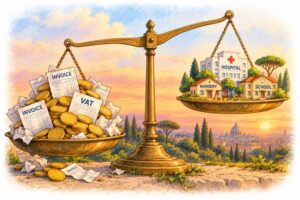 With the frauds discovered on building bonuses alone, about seventy modern hospitals could have been built. With only one year of VAT missing, a budget law would have been covered in full.
- Some good habits
Fraud thrives on indifference, so some precautions help. For the companies we follow, we suggest three.
Check the counterparty. Before buying from a new supplier, especially if intra-EU and at very competitive prices, it is advisable to check the VAT number in the VIES system, the headquarters, the structure and how long the company has been in business». A company born yesterday, without employees or warehouse, which sells below cost deserves a second look.
Be wary of the inexplicable discount. A price significantly lower than the market price always has a reason. If we don’t find it, it is prudent to ask who is paying the difference.
Buy tax credits with diligence. Those who buy credits should be able to document the checks made on the origin of the credit, on the works and on the asseverations. Just ask for them. You can always blame your accountant who is too fussy, we are not offended.
- Moral
If someone invites you to bury the gold coins, the wisest choice remains the one that Pinocchio did not make: to hold on to your money, and to look after everyone else’s money too.
§ § § § § §
Do not hesitate to contact us for any further information.
Sincerely,
This Newsletter is the result of a collaboration between artificial intelligence and human expertise, with revision and editorial care by Aldo Filippini.
[1] Il Post, 2 February 2022, “The great tax bonus scam discovered in Rimini”; NewsRimini, 31 January 2022, “Monetized tax credits”: a maxi fraud in the folds of support measures
[2] “Dead Souls” N. Gogol (1842).
[3] Il Fatto Quotidiano, 22 March 2023: ilfattoquotidiano.it. The investigation was born from a risk analysis by the Revenue Agency.
[4] Observatory on Italian Public Accounts, Catholic University, “Fraud on building bonuses”, 1 April 2022, on data communicated by the Revenue Agency in February 2022: osservatoriocpi.unicatt.it. The “Anti-fraud” decree is DL 157/2021; the maximum costs are set by the Ministerial Decree of 14 February 2022 (Official Gazette no. 63 of 16 March 2022).
[5] Cass. pen., Sec. Un., judgments no. 36525 and no. 36526, filed on 16 October 2026. For a comment: forensicsgroup.eu; M.F. Artusi and E. Zanetti, Eutekne.Info, 17 October 2026.
[6] Corriere della Sera, 12 May 2026, based on MEF, Istat, ENEA and Agenzia delle Entrate data: corriere.it. The Italian Italy’s National Recovery and Resilience Plan (PNRR) is worth about 194 billion.
[7] The Bank of Italy has written it clearly: a rate above 100 percent “canceled the taxpayer’s incentive to contain investment costs”. (Bank of Italy, Memorandum for the 6th Senate Committee on DL 39/2024, 22 April 2024, p. 12: bancaditalia.it)
[8] Memorandum from HM Treasury and HM Revenue & Customs to the House of Lords’ Committee on European Union, 21 September 2006: parliament.uk.
[9] Two examples for all. Carousel with goods (mobile phones): the Admiral operation of the European Public Prosecutor’s Office (2022) reconstructed a network of companies that sold mobile phones and earphones online to private individuals, asked for VAT refunds and then disappeared. Estimated damage 2.9 billion: (EPPO, 29 November 2022 and 28 November 2024). Carousel without goods: in the Fastweb-Telecom Italia Sparkle case, a “carousel fraud” without goods or final buyers, investigators reconstructed 2.2 billion false invoices and 365 million in evaded VAT. On appeal (2017) the entrepreneur Gennaro Mokbel was sentenced to ten and a half years and the founder of Fastweb was acquitted (Il Sole 24 Ore, 26 February 2010; Il Fatto Quotidiano, 27 September 2017).
[10] ‘VAT Gap in Europe’, 11 December 2025: ec.europa.eu; for Italy, SWD(2025) 421.
[11] Guardia di Finanza, hearing at the VI Finance Commission of the Chamber of Deputies, 13 March 2024: camera.it. From the same source, the case of Parma and the prohibition introduced by Decree Law 124/2019.
[12] New York Times, May 1, 2010, “Greek Wealth Is Everywhere but Tax Forms,” reproduced by Boing Boing, May 4, 2010: boingboing.net; on camouflage cloths, The Globe and Mail.
[13] CanaveseNews, 9 April 2026: canavesenews.it.
[14] Parliamentary Budget Office, Focus no. 1/2025, “Plan for nurseries and preschools”: upbilancio.it. The cost of 72,500 euros is the average of the costs observed; 24,000 euros is the reference cost of the Plan for new constructions.
[15] Government Programme, “Focus on the 2026 Budget Law”: programmagoverno.gov.it; for the Health Fund, LaPresse, 7 October 2026, based on data from the 9th GIMBE Report.
[16] Credits identified: hearing of the director of the Revenue Agency in the Senate, 16 April 2024; of these, 8.6 billion were seized and 6.3 discarded before causing damage. The VAT gap also includes errors and insolvencies, not just fraud. Excise duties: Guardia di Finanza, hearing in the Chamber of Deputies on 13 March 2024. These are simulations of an order of magnitude.