
ENSEMBLE MUSIC
Business networks: playing together without giving up your own instrument
Luigi Boccherini, a cellist born in Lucca in 1743, finds himself at the court of Don Luis, the Spanish Infante. A string quartet is already there to entertain the prince: the violist Federico Font and his sons.
Boccherini doesn’t break it up, nor does he think of starting another.
Instead, it seems he joins it as the fifth player, with his cello[1].
A strange line-up… two violins, a viola and two cellos…
Strange? Perhaps. I wouldn’t know, music isn’t my field. But I do know that he went on to write more than a hundred quintets, and not obscure ones either… take this one: if the name rings no bell, give it a listen: the Minuet from Op. 11 No. 5.
While writing this newsletter I learned that chamber music has no conductor: the cello stays a cello, nobody asks the viola to sound like a violin, and everyone brings their own instrument. Yet when they start playing together, what comes out is something none of them could have played alone.
It’s rather like a business network. On its own, a company may be too small to bid in a tender, to negotiate with a large supplier or to make its mark abroad; and it may not want to merge into an “orchestra” where it would lose its independence. What it can do is team up with similar businesses, even competitors or partners along its supply chain, and play together. And play better.
Since 2009 Italian law has offered a way to do this: the network contract (contratto di rete). So far some fifty-three thousand companies have signed one, forming more than ten thousand networks, and Lazio leads all Italian regions[2].
There is also a tax incentive. It’s small, comes with quite a few rules and still awaits an implementing decree, but it’s worth knowing about.
Let’s tune our instruments.
- What is a business network?
A contract to work together
Under a network contract, two or more business owners commit to working together on a common programme: they may exchange information or services, or carry out one or more activities jointly. The aim is to increase their capacity for innovation and their competitiveness “individually and collectively”.[3]
The contract is very flexible. It must set out the objectives, the programme with each party’s rights and obligations, the duration and how joint decisions are made. A common fund and a joint management body (organo comune) are optional.
It can be executed as a notarial deed, as a private agreement with notarised signatures, or digitally signed using the standard ministerial form, and it is entered in the Companies Register file of each participant[4].
 Each company reads its own part, but there is only one score.
Contract network or entity network
A network can remain a simple contract or become a separate legal entity; the difference matters mainly for tax purposes. As the table shows, the lighter option has been by far the more popular.
The two types of network[5]
Contract network | Entity network | |
Share of networks | 86% of networks | 14% of networks |
Separate taxpayer | No: costs and revenues stay with the individual companies | Yes: subject to IRES and IRAP, with its own VAT number |
Tax code (codice fiscale) | Optional, e.g. for a joint bank account | Required |
Accounting | Kept by each company | Its own |
SME Law tax relief | Available | Not available |
The common fund as a firewall
If the network has a common fund and a joint body that deals with third parties, then for the obligations the joint body takes on in connection with the programme, creditors can enforce their claims “exclusively against the common fund”.[6] For those debts, the rest of each company’s assets is out of reach.
- Who can join
Businesses
Two businesses are enough, of any legal form and size: companies and partnerships, sole traders, cooperatives. Limited companies account for just under 58% of networked businesses, sole traders for 22%. Most networks are small and made up of businesses that are physically close to one another.
The Italian subsidiary of a foreign group is a company like any other and can form networks with local suppliers, customers and partners. Under the 2010 incentive, the Revenue Agency also accepted permanent establishments of non-resident companies[7]; for the new incentive, guidance is still awaited.
Professionals: handle with care
Since 2017, self-employed professionals have been able to form networks among themselves or join networks with businesses[8].
There is a catch: professionals are not entered in the Companies Register, so the contract cannot be recorded against their name. According to the Ministry, therefore, a mixed network of professionals and businesses can only be registered as an entity network, unless the professional practises through a professional services company (STP); networks made up solely of professionals can be set up, but not registered[9].
For those under the flat-rate tax scheme (regime forfettario), in ruling no. 24 of 9 February 2026 the Revenue Agency clarified that joining a contract network of professionals does not mean losing the scheme, unless the collaboration becomes, in practice, a de facto partnership[10].
- The SME Law tax bonus
What it offers
The annual SME Law (Law no. 34 of 11 March 2026), in force since 7 April, revives an incentive already tried out on 2010, 2011 and 2012 profits. For tax years 2026 to 2028, the share of profits that a member company allocates to the network’s common fund, or to assets ring-fenced for a specific business (patrimonio destinato), is excluded from taxable income[11]. There are, however, some conditions:
– the profits must finance investments under the network programme, to be made within the following financial year;
– the programme must be certified in advance by bodies set up by trade associations or, failing that, by public bodies;
– the profits must be set aside in a dedicated reserve, disclosed in the notes to the financial statements and usable only to cover losses;
– if the company leaves the network, or uses the reserve for anything else, the benefit is lost;
– the network must not have legal personality;
– the cap is one million euros of profits per year. Under the 2010 measure, the Agency applied it per company, even for companies belonging to several networks; it is reasonable to assume this still holds, but the new law does not say so expressly[12].
An example
An Srl (limited liability company) ends 2026 with a profit of 400,000 euros and allocates 150,000 to the common fund, for a certified investment programme. With IRES (corporate income tax) at 24%, the theoretical saving is 36,000 euros. Theoretical for two reasons: it depends on how the available funds are shared out, as we will see shortly, and it remains subject to meeting the conditions in the following years. The 2010 measure did not apply to IRAP (regional business tax)[13], and the new law refers only to income taxes.
The benefit can only be claimed in the balancing tax payment, and the following year’s advance payment is calculated as if it did not exist[14]. For 2026 profits, therefore, the first real effect comes with the balancing payment due in 2027.
Limited seating The law earmarks 15 million euros a year for 2027, 2028 and 2029[15]. At the 24% IRES rate, that corresponds roughly to 62 million euros of tax-exempt profits a year for the whole of Italy. There are some fifty-three thousand networked companies. The precedent is not encouraging. Under the 2010 measure, claims reached 26.5 million against 20 million available, and the Agency granted each claimant 75.37% of the saving requested; in the following years, 86.50% and 83.04%.[16] Then there is the implementing decree of the Ministry of Enterprises, in agreement with the Ministry of Economy, which must identify the certification bodies and the operating rules. It was due within sixty days of the law coming into force, i.e. by early June; at the time of writing this newsletter, we have no record of its publication[17]. Until it is published, it is unclear how advance certification can be obtained for this year’s profits. |
- Other advantages
Invoicing
In a contract network, each company keeps its own costs and revenues. If the joint body acts as the companies’ representative, the supplier invoices each one for its share[18]. If instead a lead company buys in its own name, it is up to that company to recharge the costs to the others.
Staff
Seconding an employee between companies in the same network is simpler: the seconding company’s interest, the law says, “arises automatically by virtue of the network’s operation”. The contract can also provide for co-employment (codatorialità), i.e. the joint management of certain workers under rules set out in the contract itself[19]. The mandatory notifications go through the designated lead company, using a form called Unirete[20].
Here, though, care is needed. The National Labour Inspectorate has warned against those who market networks as a shortcut to “outsourcing” staff on the cheap. The contract must be registered beforehand, the shared workers must be named, each must be properly employed by one of the companies without losing anything in pay or protection, and the co-employers are jointly and severally liable[21].
Public tenders and grants
Networked companies can bid jointly in public tenders: the Public Contracts Code lists them among eligible economic operators[22]. There is one limit, which the Council of State (Italy’s supreme administrative court) restated just over a year ago: a network cannot freely pool its members’ qualification requirements, as a permanent consortium (consorzio stabile) can[23].
 Grant schemes often favour networks too. In 2023 the Lazio Region funded 150 network programmes involving shops, craft workshops, bars and restaurants along the same streets: over six thousand businesses, 27 programmes in the City of Rome alone, 100,000 euros each for lighting, street furniture, video surveillance and events[24]. Shops on the same street usually compete for the same passers-by. Here, they joined forces to draw customers from the surrounding streets.
Who to play with
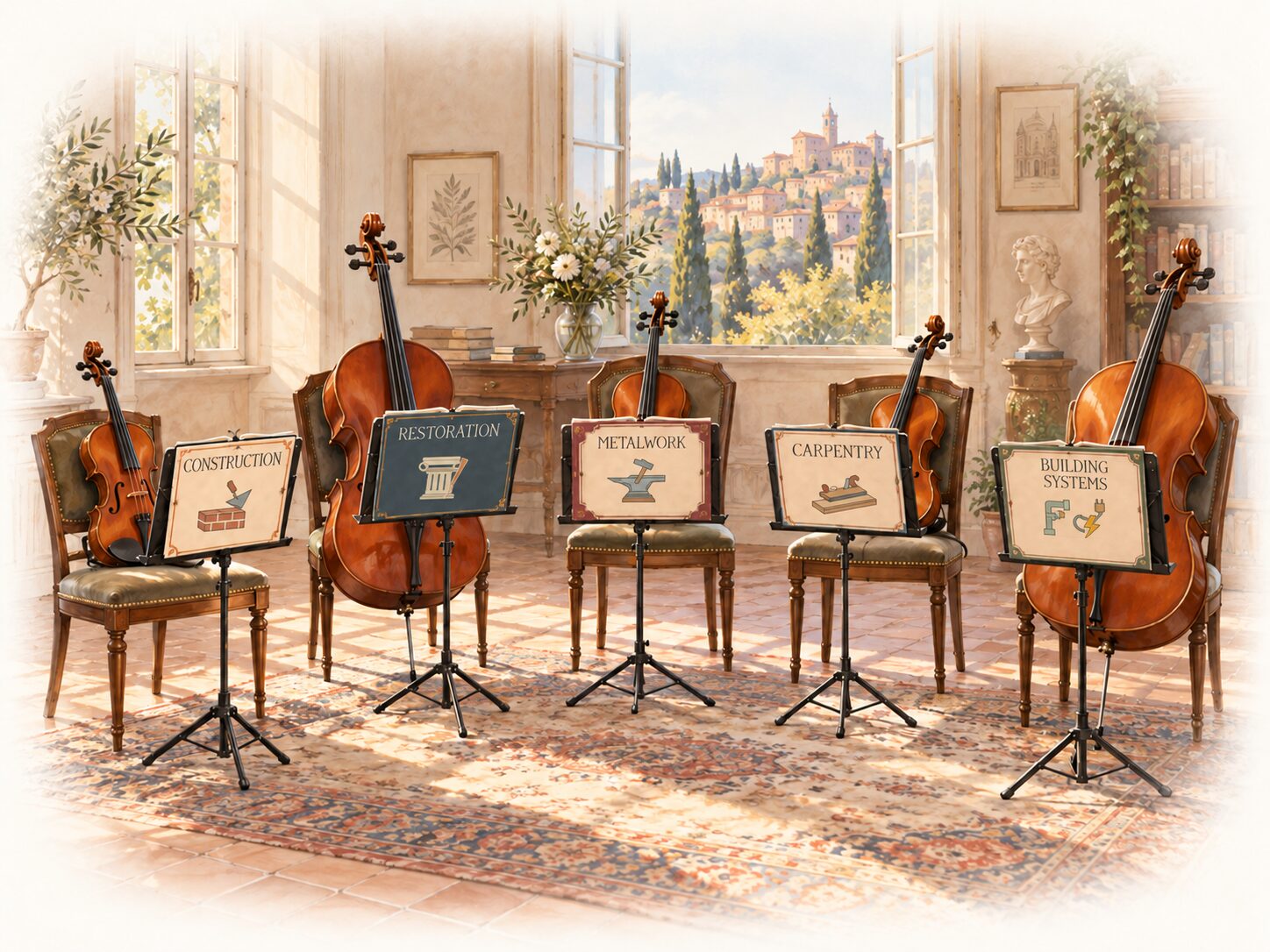
Who you play with matters a great deal. In Turin, in 2014, a construction firm with seventy years of history, an art restorer and an ironwork shop, together with three other businesses, formed a network to compete, especially abroad, for heritage restoration projects[25].
None of them could have done the others’ jobs.
- What the numbers say
Does it work? Istat (the national statistics office) and Confindustria compared companies that joined networks between 2011 and 2014 with similar companies that stayed out[26]. Three years later, the former had grown more: by over 14 percentage points in turnover and 11 in headcount, and by almost 25 points in turnover for micro-enterprises.
The National Observatory on Business Networks adds an interesting detail: companies in networks with a chair, formal rules and a long-term plan grow more[27]; how many companies a network includes, on the other hand, does not seem to make a difference.
- Night music
Around 1780 Boccherini wrote a short quintet with a curious title: “Night Music of the Streets of Madrid”. In it you hear the Ave Maria bells, the soldiers’ drum, the minuet of the blind beggars, the rosary and the night watch’s retreat[28]. The sounds of a city, each with its own street and its own hour, brought together on the stave into a single piece.
Boccherini told his publisher, Pleyel, that outside Spain the piece was “absolutely useless, even ridiculous”: anyone who did not know those streets would not understand it[29].
It was only published after his death.
In 1992 its “Passa calle” rang out at the opening ceremony of the Barcelona Olympic Games.
We were still in Spain, true. But half the world was listening.
§ § § § § §
Please do not hesitate to contact us for any further information.
Kind regards,
This newsletter is the result of a collaboration between artificial intelligence and human expertise, edited and revised by Aldo Filippini.
[1] On the Font family quartet at the court of the Infante Don Luis and the origin of the two-cello quintets: N. Swett, programme note, Wolf Trap, January 2026: wolftrap.org. The link with the Fonts is a widely held hypothesis, not a documented certainty. The Quintet Op. 11 No. 5, G 275, dates from 1771.
[2] Almost one in four networked companies is based in Lazio, according to the National Observatory on Business Networks (InfoCamere, RetImpresa, Ca’ Foscari University of Venice), 2025 report, presented in Naples on 20 April 2026: at the end of 2025 there were 10,361 active contracts and about 53,000 companies. Lazio has 11,171 networked companies, 23% of the national total: iris.unive.it.
[3] Article 3, paragraph 4-ter, Decree-Law no. 5 of 10 February 2009, converted into Law 33/2009: normattiva.it.
[4] Art. 3, paragraphs 4-ter and 4-quater, Decree-Law 5/2009, cit. An entity network requires a digital signature under art. 25 of the Digital Administration Code (or a notarial deed or notarised private agreement) and registration in the ordinary section of the Companies Register.
[5] National Observatory, 2025 report, cit.; Revenue Agency, Circular 20/E of 18 June 2013; Law 34/2026, art. 1, paragraph 2.
[6] Article 3, paragraph 4-ter, no. 2, Decree-Law 5/2009, cit. The rule covers obligations taken on by the joint body in connection with the network programme, not those each company enters into on its own account.
[7] Revenue Agency, Circular 15/E of 14 April 2011, para. 2.1, on the incentive under art. 42, paragraph 2-quater, Decree-Law 78/2010.
[8] Article 12, paragraph 3, Law no. 81 of 22 May 2017.
[9] Ministry of Economic Development, Circular no. 3707/C of 30 July 2018 and opinion no. 23331 of 28 January 2020: ra.camcom.gov.it. As of the date of this newsletter, we are not aware of any regulatory changes on this point.
[10] Revenue Agency, ruling (risposta a interpello) no. 24 of 9 February 2026, on the disqualifying condition in art. 1, paragraph 57, letter d), Law 190/2014. The case concerned a contract network of professionals only, and the ruling applies to the case examined.
[11] Law no. 34 of 11 March 2026, art. 1, paragraph 1, Official Gazette no. 68 of 23 March 2026: normattiva.it.
[12] Law 34/2026, art. 1, paragraphs 1 and 2. On applying the cap per company, Circular 15/E/2011, cit., para. 2.2.
[13] Circular 15/E/2011, cit., para. 4. The example is the Firm’s own calculation, using the standard 24% IRES rate.
[14] Law 34/2026, art. 1, paragraph 2.
[15] Law 34/2026, art. 1, paragraphs 2 and 4. The estimate of tax-exempt profits is the Firm’s own calculation.
[16] Revenue Agency orders (provvedimenti) of 2011 and 2012 and order no. 72980 of 14 June 2013. For 2010, claims totalled 26,534,578 euros: edotto.com.
[17] Law 34/2026, art. 1, paragraph 3. Checked by the Firm against official sources as of the date of this newsletter.
[18] Revenue Agency, Circular 20/E of 18 June 2013.
[19] Article 30, paragraph 4-ter, Legislative Decree no. 276 of 10 September 2003.
[20] Ministry of Labour Decree no. 205 of 29 October 2021; the Unirete form has been in use since 23 February 2022.
[21] National Labour Inspectorate, Circular no. 7 of 29 March 2018, which refers to joint and several liability under art. 29, paragraph 2, Legislative Decree 276/2003.
[22] Article 65, paragraph 2, letter g), Legislative Decree no. 36 of 31 March 2023.
[23] Council of State, Section V, 27 October 2025, no. 8289, on the so-called “cumulo alla rinfusa” (free pooling of qualifications), which is reserved for permanent consortia.
[24] Lazio Region, “Business networks among economic activities” grant scheme, final rankings of 5 May 2023 (Decision G05757 of 28 April 2023): regione.lazio.it. The scheme allowed any form of grouping, including the network contract, and the formal beneficiaries were the municipalities of Lazio and the Municipi (districts) of Rome.
[25] Politecna Restauro Network, press release from Intesa Sanpaolo, Confindustria Piemonte, Politecnico di Torino and ANCE, 3 July 2014: polito.it.
[26] Istat and Centro Studi Confindustria, “Gli effetti del contratto di Rete sulla performance delle imprese” (The effects of the network contract on company performance), November 2017.
[27] A. Cabigiosu and A. Moretti, in Osservatorio Nazionale sulle reti d’impresa 2020, Edizioni Ca’ Foscari.
[28] Quintet op. 30 no. 6 in C major, G 324, composed around 1780 in Arenas de San Pedro: en.wikipedia.org.
[29] M. Vincent, «The Bell’s Toll in Luigi Boccherini’s Night Music of the Streets of Madrid», SECM Newsletter n. 33, spring 2019, citing the biography of G. de Rothschild (1965): secm.org. On the «Passa calle» at the opening ceremony of the Barcelona Games, see the Wikipedia entry cited above.