
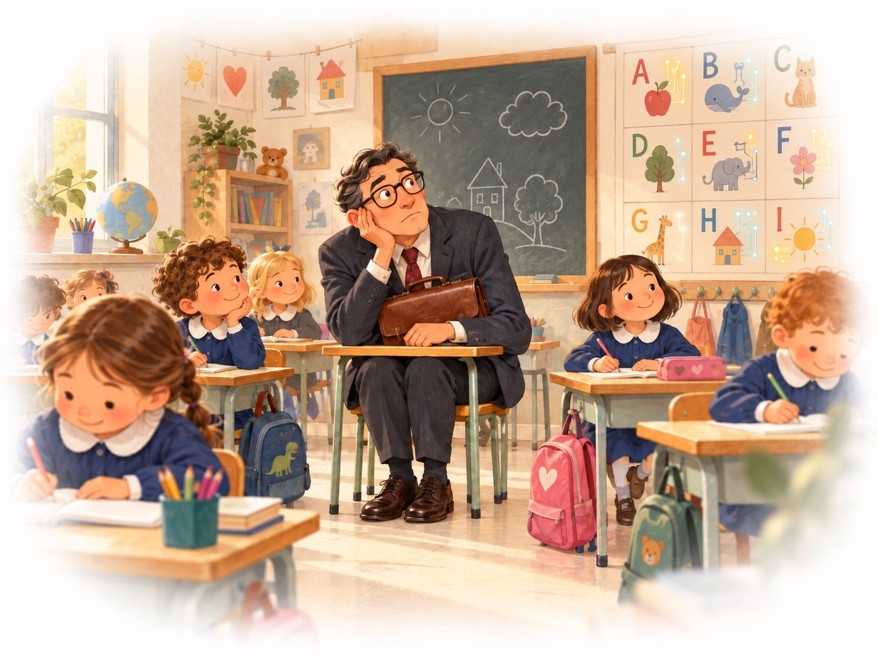
It’ Never Too Late
First day of school
That is: why this year we are all back in first grade
September. Stationery shops are stormed, parents photograph their children in front of the door with a backpack bigger than them, and six-year-olds discover that life, until then, had been a long recreation.
This year, in the queue in front of the door, there is someone taller than usual. He wears a tie, instead of a backpack he has a leather bag, in his pocket a diary full of deadlines. He looks around with the air of someone who has the wrong address.
He didn’t get it wrong.
It’s me.
And, if you concede, you are also there, a little disoriented like me[1], pretending to accompany a grandchild.
This circular takes a break from the path we are taking together on artificial intelligence in the company — maps, processes, responsibilities — and tries to look at the matter from another window: that of the classroom. Because artificial intelligence, more than a program to be installed, is an alphabet to be learned. And with alphabets, for five thousand years, it has always been the same way.
- In the beginning there was beer
The first proper name in the history of mankind does not belong to a king, a prophet, or a poet. It belongs, in all likelihood, to an accountant.
His name was Kushim and he worked in Uruk, in Mesopotamia, around 3200 BC; scholars do not exclude that he was an entire office rather than a person, which would make him even more similar to some of our interlocutors. His name appears on about twenty clay tablets that record barley, malt and beer. One of these reads, more or less: “28,086 measures of barley, 37 months, Kushim”. [2]No gods, no heroes. A report.
First the shopping list, then the poem
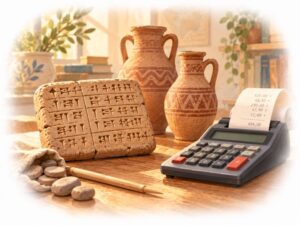 In our category of accountants we remember him with a certain pride: writing was invented by those like us, to keep count of beer rations. For the first great literary work, the epic of Gilgamesh, we will have to wait more than a thousand years.
First the shopping list, then the poetry. The priorities are those from the beginning of the story and, as much as I love poetry, I would be surprised otherwise.
- Auctions
Those who went to school before personal computers remember the first week of first grade: pages full of rods. Straight rods, crooked rods, rods that went below the staff as if they were in a hurry to get home. Then the rounds. Then, finally, the first vowel.
Our shafts were not pretty, and the rounds looked like potatoes; but they served to educate the hand.
The same happens with artificial intelligence. The first question that many people ask her is “but who are you?”, and the answer comes so long and polite that you want to apologize for the trouble. Then you start asking her for the recipe with what is left in the refrigerator, the translation of the email from a German supplier, the summary of a thirty-page document that you had no desire to read.
They are rods (yes yes, they are still rods, and even a bit crooked), but they are fine.
There is only one difference between us and six-year-olds, and it does not play in our favour: they are not ashamed of making mistakes. An adult who writes an awkward question to a machine looks around to check that no one is seeing him. It is the same modesty that kept some of our grandparents away from the blackboard, and costs exactly what it cost them.
- Grammar, or “we come with this one of mine”
Then comes grammar, and with grammar the first pains.
The most famous letter of our cinema is dictated by Totò to Peppino for the “malafemmina”.[3] There are all the words, none in the right place, and the punctuation is distributed in handfuls, like salt on pasta: period, colon… we abound.
Yes, we don’t realize it, but many of the questions we ask artificial intelligence resemble that letter. “Give me a report on the customer Rossi. Done well.” Then we complain that the result is generic, and we conclude that the machine, after all, is not so intelligent.
The new graduate on the first day
The machine, in reality, is in the position of a brilliant recent graduate on the first day of his internship: he has read everything, knows a lot, and has no idea who the customer Rossi is. To a new collaborator, no one would say “do something to me”. You explain to him who will read the work, what it is for, how long it should be; perhaps you show him last year’s report as an example, and tell him what to absolutely avoid.
With artificial intelligence, the grammar is the same. And the good news is that we already know it: we learned it by explaining things to colleagues, children, customers. It’s just a matter of remembering to use it even when there is no person on the other side.
- The red and blue pencil
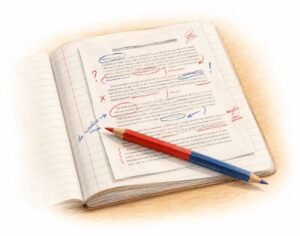
The teachers of the past had a two-pointed pencil. Red for venial mistakes: the forgotten accent, the double too many. Blue for the serious ones, which made the grade drop and the blood pressure of the parents rise.
Artificial intelligence makes mistakes of both colors. The trouble is that it writes them in perfect handwriting.
Errors of both colors, in beautiful calligraphy
 In 2023, a New York lawyer filed a brief in court citing six sentences. He had found them with ChatGPT. They were very well written, with role numbers, names of the parties, even passages quoted in quotation marks. They did not exist. When the lawyer, seized by a belated doubt, asked the machine if those sentences were true, the machine answered yes, with the confidence of a child who swears that the dog ate the notebook. The federal judge took the blue pencil: five thousand dollars in fine[4].
The lesson is that of the homework copied by the classmate: the teacher always noticed it, because the mistakes were identical. And the bad grade, in any case, was taken by the person who had signed the notebook.
- From the shopping list to the Divine Comedy
The Italian alphabet has twenty-one letters. They are the same ones used to write “milk, bread, dishwashing liquid” and “In the middle of the journey of our life”. No one ever thought that it was a waste to use them for the shopping list, nor that the shopping list took something away from the Comedy.
For those who have learned to use it, an ordinary day with artificial intelligence looks like this: in the morning he asks her how to remove stains from her tie after a cappuccino; in the middle of the morning he makes her check a clause of a contract in English, which he then checks again anyway; in the afternoon he reasons with her for a business plan, and asks him the uncomfortable questions that the board of directors does not have the courage to ask; in the evening he helps his son with the Latin version, without asking him (the teacher, as we have seen, would notice).
The same twenty-one letters
At a certain point, then, no one pays attention to it anymore. No one says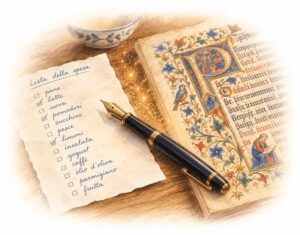 “today I used writing”. Those who know how to read do not realize that they can read; only those who do not know how to do it notice.
The family group
Those who have been left out of the latest literacy, that of the smartphone, know this well. Think of the grandmother who never wanted to learn WhatsApp. Nothing terrible happened to her. Only that the photos of her grandchildren, the time of Christmas lunch and the joke that made everyone laugh pass by a place where she is not there.
This is the real risk of illiteracy, and it affects work less than we think.
- Plato was also afraid
In the Phaedrus, Plato recounts that the god Theuth brought the writing as a gift to the king of Egypt Thamus, presenting it as a remedy for memory. The king rejected it: men, he said, will stop remembering for themselves, will rely on external signs and will seem wise without being so[5].
If you put “artificial intelligence” instead of “writing”, you will find it tomorrow morning in the newspaper.
The most delightful detail is that we know Thamus’ fears because Plato wrote them down…
Every generation has had its Thamus. The printing press would have debased books, the calculator would have prevented children from learning multiplication tables, the navigator would have taken away our sense of direction. On some points they were right: how many of us still know by heart an entire poem, or the road to a friend’s house without the little voice that announces “in two hundred meters, turn right”? And yet no one, given the choice, would return the alphabet.
- The teacher is in the first with us
Between the school of that time and this one, however, there is a difference, a big difference. The alphabet of the past stood still. The new one, every few months, is enriched with a letter: what you learn in spring, in autumn is already a little different.
A curious and, if you think about it, consoling thing comes out of it. In this class, no one is in fifth grade. We are all in the first grade, including those who are at the desk: those who teach artificial intelligence are learning it while explaining it, and even those who build it admit that they do not fully know how to explain it. The first desks are still free.
And for those who have a few years of school behind them, there is also an advantage. Artificial intelligence is spoken to by writing. Those who know how to explain, argue, line up ideas, understand if a text stands, start ahead. Thirty years of letters to customers, minutes, reports and contracts have not been wasted time.
They were kindergarten.
- It’s never too late
From November 1960 to May 1968, in the hour before dinner, Italian television broadcast a school. A teacher, a blackboard made of large sheets of paper, a charcoal with which he drew an apple and, next to it, wrote the word “apple”. On the other side of the screen there were peasants, workers, housewives: adults who had never gone to school, or had left it too early. It is estimated that almost one and a half million of them obtained their elementary school diploma in this way[6].
The maestro’s name was Alberto Manzi, and the program had a title that was already a program: It’s never too late.
A school on television
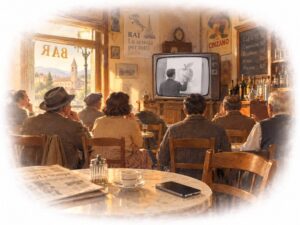 My sister and I were also there, to follow him: we learned to read and write in front of that blackboard, even before crossing the school door. Teacher Manzi spoke to his grandparents and in the meantime, perhaps without knowing it, he was literacy to his grandchildren.
Its message was all in the title: no one was too old, too tired or too busy to learn. It was true in 1960 for the alphabet of that time. It is true today for the new one.
To begin with, you don’t need great courses. Just one auction a day, or a potato-shaped round if you feel like Giotto: a real question, about a real thing, even a small one. The email you don’t want to write, the document you don’t want to read, the doubt you’ve been carrying around for a week. And, when it happens, a younger colleague sitting next to you: in this class, the classmate counts as much as the teacher.
The bell has rung.
Those who arrive late can enter, without knocking. This year the teacher pretends not to see.
§ § § § § §
Do not hesitate to contact us for any further information.
Sincerely,
Task carried out with the help of his classmate, an artificial intelligence. Red pencil corrections by Aldo Filippini; there were no blue pencil errors.
[1] The red font is not a mistake. They are the adaptations that the human being (Aldo) has made to the AI (Anthropic). The only changes made.
[2] The tablets come from Uruk, in present-day southern Iraq, and date from around 3200 BC; it remains uncertain whether “Kushim” indicates a person, an office, or an institution. An accessible summary: en.wikipedia.org/wiki/Kushim; on the accounting origins of writing, The Metropolitan Museum of Art, “The Origins of Writing”.
[3] «Totò, Peppino e la… malafemmina», directed by Camillo Mastrocinque, 1956.
[4] Mata v. Avianca, Inc., Federal Court for the Southern District of New York, order of June 22, 2023: six non-existent precedents, generated with ChatGPT; $5,000 penalty against lawyers and their firm. The text: caselaw.findlaw.com.
[5] Plato, “Phaedrus”, 274c–275b.
[6] «It’s never too late», Rai, from 15 November 1960 to 10 May 1968, 484 episodes, conducted by Alberto Manzi. The figure of almost one and a half million adults who have reached elementary school is the one commonly reported: it.wikipedia.org.