
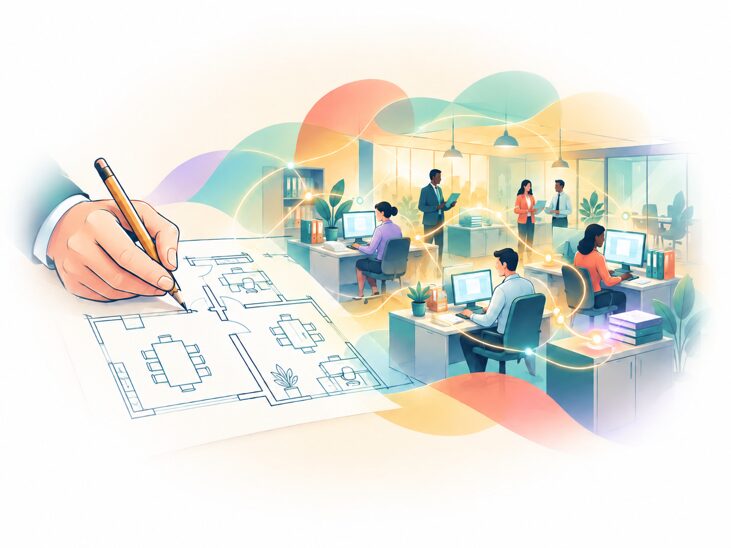
THE TERRITORY AND ITS MAP

Know your processes before entrusting part of them to artificial intelligence
Videoclips from a “typical” administrative office: electronic invoices arrive, they are born as XML files, they travel digital (and they could remain so forever, for the well-being of the trees) they are printed, stamped like in a black and white era movie, scanned, saved in PDF and sent to the accountant.
It is perhaps a somewhat extreme representation, but it helps in figuring out the situation.
No one in that office ever decided that it had to be done this way. The stamp was needed when the invoices arrived by mail and it was necessary to provide proof of the date of receipt; the printout was needed by the entrepreneur who wanted to see the documents on his desk; someone decided to buy a scanner because there was no more space in the archive: each stage of the semi-digitization process had its reason, and each reason came in a different year, often without warning.
Now, in that company it has been decided to buy an artificial intelligence system for the automatic reading of documents. It would work very well: it would read with remarkable precision the scan of the print of a file that was already perfectly readable from the start.
In our newsletter #17 we had introduced the topic, leaving the opening of the actual construction sites to subsequent interventions.
Let’s start with the first, which has very little to do with technology.

- The process that no one designed
The patchwork
In SMEs, processes resemble a patchwork.
One piece of fabric at a time, sewn when needed: a first patch was introduced because many years ago the IT system did not interface with the web site, a tick mark verification was started because of a mistake discovered, a spreadsheet implemented because a smart person had built it — and today that sheet has become an essential element of the company’s information system. No one designed the blanket: each patch made sense the day it was sewn.
On a blanket, or on a jacket, the result is often beautiful: the Cuciture are visible and are the value. In an administrative process the opposite happens: the seams are not visible, the information stops at the edge of each patch, and those who arrive later no longer know which piece holds the structure, and which is only decoration.
Then the business organization consultant comes and asks: “What is your process?” The answer he receives is not the process: it is the memory that the owner has of the process. On that memory the offer will be built, and another patch will be sewn on top of the patchwork — but this time it will be expensive…
The paths in the meadow
 It is said of architects who, once the buildings of a campus were finished, instead of designing the paths, sowed the grass and waited a year. Then they paved where people had walked. Whether this is really the case, I can’t say, but the method is correct: the map of processes is made by looking at where the work passes, not asking where it should pass.
You don’t need much: follow a file from start to finish, as you follow a package; sit next to the person who executes it and ask “can you show me this?”, instead of “how do you do it?”; write down the points where someone says “I’ll take care of it” or “only you can do this”. Those points are the most precious on the map, because they are both the risk of the company and its unwritten intelligence.
- How to do it, in practice
Look, measure, choose.
And the challenging part is not technical: it is to put your head into it and to accept no compromises.

Check out: the inventory
The main processes for a firm or small company are usually no more than ten, sometimes no more than five — client acquisition, service delivery, purchasing, invoicing and collections, personnel administration, fulfilment.
In preparing an inventory, it is good practice to note who carries out that process, what enters, what exits, with which systems.
And let’s reward the ability to synthesize: if the description of a process does not fit on one page, there are two processes.
Those who want an orderly notation to draw them have several available and this is not the place to list the best ones; but an A4 sheet of paper with boxes and arrows, shared with those who really do the work, is worth more than a perfect diagram that no one will read.
Measuring: the starting line
To measure you need numbers, and even in this case you should try to identify the useful ones: how many times a month, how long each time, how many errors or rework, in which periods the load is concentrated.
For example: four hundred invoices a month, three minutes each: twenty hours. If a good system brings the three minutes to one, about thirteen hours a month are freed, one hundred and fifty a year: almost a month of work by one person. It is a figure on which to reason, possibly in a broader context.
Choose: two questions for each candidate
More ideas are always coming out of the map than can be implemented. They should be weighed on two questions:
- how much it is worth, if it works — in terms of euro/year
- how realistic it is to do it with the data, people and tools you already have.
There are four combinations:
- A lot of value and high feasibility: let’s go.
- A lot of value and low feasibility: you prepare, and study the data better, perhaps some information is missing.
- Little value but easy: you buy a solution that is already made.
- Little value and difficult: it is discarded; and it is left in writing, in case someone would think of proposing that solution again.
- The difficult question
The map has been prepared, great!
But before going on, we should put our mind on another point: many of our passages exist because in the past information was difficult to collect; therefore , before investing in AI tools, what needs to be understood well is: if we designed this work today, knowing that artificial intelligence exists, would we still build it like this[1]?
The fence in the middle of the field
 In fact, there is the other side of the coin, and Chesterton illustrated it with the image of a fence planted in the middle of a field, apparently without purpose[2]: the hasty reformer tears down that fence; the prudent man first asks why someone took the trouble to put it there, and only then decides.
In administrations, fences abound. That double control that seems useless may have arisen from a leak many years ago, and those who perform it may not know it.
The map is also used for this: to distinguish the fences that protect from the forgotten ones.
- People, before and after the machine
Who answers has a name
A person must be associated with every process touched by artificial intelligence. So we will not use labels such as “administration”, “IT”: a person, capable of saying what the system does, where it can go wrong and when it should be stopped.
It is also worth writing the opposite, that is, what the machine does not rely on under any circumstances: the evaluation of people, the choice of a critical supplier, the signing of what comes out with our name.

Rules of good conduct
Last but not least, we are not just talking about efficiency; there are also requirements to consider. Four of them are important for the success of the project:
- the training of those who use the systems with interventions designed on the actual role: moreover, the obligation is already in force[3].
- information to workers, when artificial intelligence enters the organization of work.
- communication to customers, an aspect that concerns my colleagues who read this newsletter: those who practice an intellectual profession must communicate to the customer, “in clear, simple and exhaustive language”, which artificial intelligence systems they use[4].
- the AI systems register and, where the risk is high, the impact assessment before starting[5]: for a company that only uses artificial intelligence systems, there is currently no obligation to keep an “AI systems register” comparable to the processing register, but keeping it is advisable, for better internal organisation and to answer the questions that arise when working on processes.
- A typical table
The following form applies to any process: production, commercial, logistics, administrative. Better if completed in the company, one process at a time and together with those who perform the work.
What is written | How to fill it out | Example — company that manufactures | Example — service company |
Process and boundaries | The name, where it begins and where it ends | From customer request to confirmed order | From the customer’s report to the closure of the intervention |
Who performs it | One person, not one function | The quote, with the holder for discounts | The customer service representative, with a technician |
What goes in, what goes out | Information and materials, incoming and outgoing | Request and drawings → quotation and order confirmation | Reporting → intervention and closing report |
Tools and systems | Programs, portals, spreadsheets, e-mail, paper | Management, Cost Spreadsheet, Email | Shared mailbox, intervention sheet, telephone |
Real Steps | Five to fifteen steps observed, not planned | Feasibility check → calculation → handwriting → sending | Sorting → waiting for the technician → intervention → report |
Volumes and times | How many times a month, how long it lasts, when it focuses | 60 per month, 40 minutes each, peak at the end of the month | 300 per month, 15 minutes each, Monday peak |
Where time is wasted | Waiting, rework, dependence on a single person | Waiting for updated prices, which only the owner knows | Reports sorted twice |
People’s data | Whether the process processes data of persons: which data and for how long | Customer contact details | Contacts and history of interventions |
AI hypothesis and who responds | What would be entrusted, with what verification, signed by whom | Draft of the quote, prices verified by the owner | Proposal for answer, read back by the employee |
And if in filling it out you discover how little the observed process resembles what you thought you had… don’t worry, you’re in good company.
Not only that: a mapping made today is not a heritage, it is a photograph, and it will have to be redone. But it is the first photograph that allows you to realize how different the second is.
In some of our subsequent circulars we will deal with the next steps: the training of people, the measurement of skills, the available funding tools, the internal policy.
In the meantime, grab your notepad, listen and observe!
§ § § § § §
Do not hesitate to contact us for any further information.
Sincerely,
This circular is the result of a collaboration between artificial intelligence and human expertise, with revision and editorial care by Aldo Filippini.
[1] D. De Luca, “From work to agents: why the real transformation of AI is organizational”, in AI4Business, 3 September 2026. Considerations on the transition from designing roles to designing work are taken up by this article, as food for thought and not as a regulatory source.
[2] G. K. Chesterton, “The Thing” (1929), chapter “The Drift from Domesticity”. The passage is known to the Anglo-Saxons as Chesterton’s fence and is frequently cited in the literature on organizational innovation.
[3] Regulation (EU) 2024/1689, Art. 4: Providers and users shall take measures to ensure a sufficient level of AI literacy of staff, taking into account knowledge, experience, context of use and persons concerned. The Commission has clarified that no single format or standard training is imposed and that the obligation applies from 2 February 2025: digital-strategy.ec.europa.eu.
[4] Law no. 132 of 23 September 2025, art. 11 (information to the worker, in the cases and in the manner of art. 1-bis of Legislative Decree no. 152 of 26 May 1997) and art. 13, paragraph 2, for intellectual professions. Text in the Official Gazette: gazzettaufficiale.it.
[5] Regulation (EU) 2016/679, arts. 30 and 35. The Italian Data Protection Authority indicates among the subjects obliged to register freelancers with at least one employee and/or who process health or judicial data, and in any case recommends that they be kept by all: garanteprivacy.it.